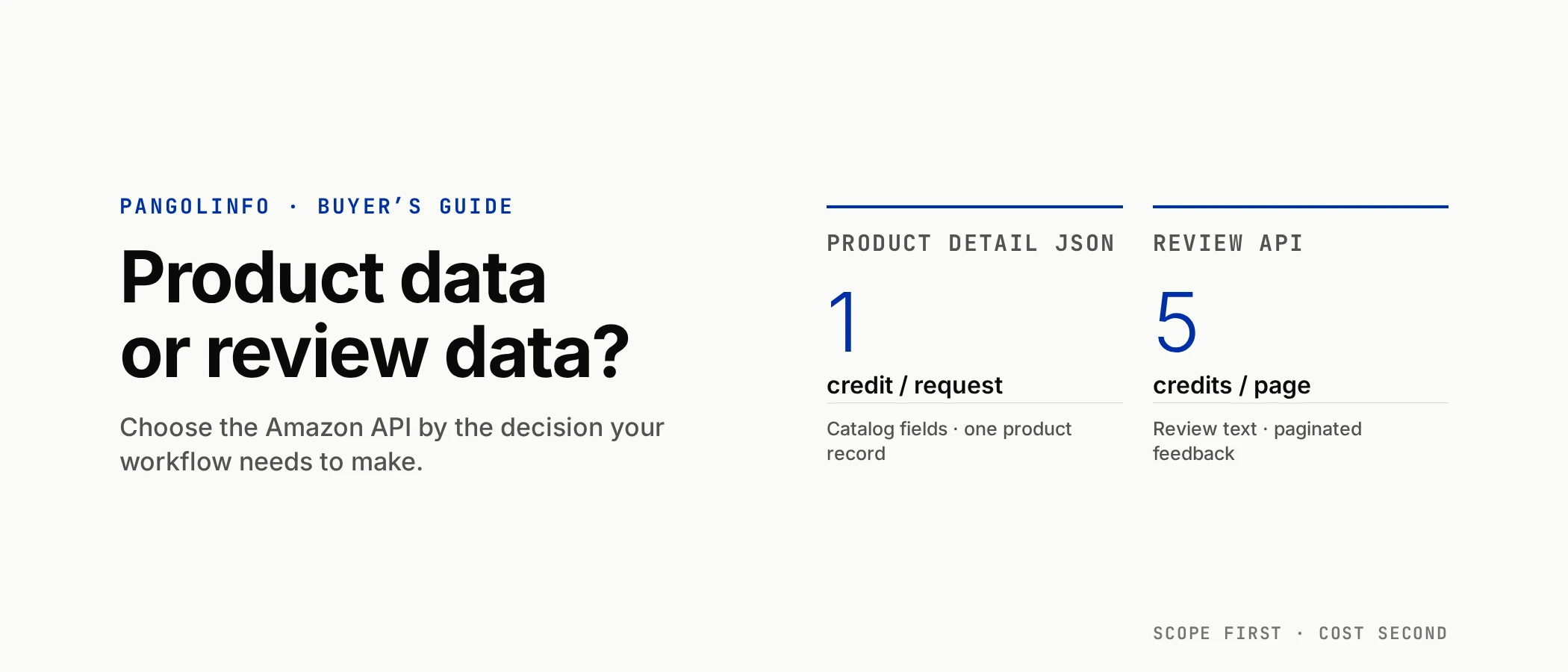
“I need Amazon product data and customer reviews—should I call one API or two?” Start with the record your application needs. The main Scraper API is for product, search, category, seller and ranking pages; review-page collection is a separate product with review-specific filters and billing. If you need both catalog context and review text, plan for both calls rather than assuming a product record contains a full review feed.
Choose by the output you must store
| Your workflow needs | Start with | Why |
|---|---|---|
| A structured product record for an ASIN | Product Detail | Returns product-page data as JSON, such as the fields exposed for that page and marketplace. |
| Review text, ratings, review-page filtering or media reviews | Amazon Review API | Has review-specific pagination and filters, including star and media scope. |
| A product record plus customer feedback | Both, if needed | Join results by ASIN and marketplace; refresh each data set on its own schedule. |
The current Amazon Scraper API page documents six main parser templates: product detail, keyword search, category products, seller products, Best Sellers and New Releases. The Product Detail reference describes the JSON response and its 1-credit-per-request rate. It is the right starting point when the record is about the product itself—not when your downstream task requires page-by-page review text.
The separate Amazon Review API is designed for review data. Its reference describes `pageCount`, star filters, sorting, all-format versus current-format scope, and an option to request only reviews with images or video. Confirm the target marketplace and exact fields in the live Review API documentation before implementing: endpoint availability and returned values can depend on the selected page and marketplace.
A useful distinction: product rating is not the review corpus
A product page may expose summary fields that help you shortlist or monitor an item. That can be enough for a catalog, price-monitoring workflow or a first-pass competitor table. But if your feature needs the language customers used, a set of individual ratings, dates, helpfulness signals, or review media, define those as review records and request the review endpoint. Don’t design a sentiment pipeline around a single summary field.
Conversely, a review feed alone may not carry every product attribute your application needs. If you need to associate customer feedback with product-page context, request both deliberately and store the source marketplace and ASIN with each result. This makes mismatches, variations and subsequent refreshes easier to audit; it does not guarantee that every request returns every field for every listing.
Keep the query narrow. The Review API lets you choose all reviews or media-only reviews, select all product formats or the current format, and filter by star rating in its documented request. These are different data scopes, not free ways to request the same full corpus. Decide whether you need breadth for exploration or a targeted slice for a specific customer question.
Estimate credits using pages, not review counts
Under the current official references, Product Detail JSON is 1 credit per request; Review API collection is 5 credits per page. A review page is not one review. Its requested page count, filters and actual response affect the collected data; the API response’s pointCost is the best record of the charge for a completed call.
product detail credits = product JSON pages × 1
review credits = review pages × 5
total = product detail credits + review credits + other operations
For example, suppose a monthly check covers 20 ASINs, with one product-detail JSON page and three review pages per ASIN. The estimate is 20 × 1 + 20 × 3 × 5 = 320 credits, before other endpoints, retries or extra refreshes. The Review API reference allows `pageCount` from 1 to 10 for a request; if a product needs more than that, plan the additional requests explicitly. Actual consumption should be reconciled against pointCost, not inferred from the number of reviews returned.
The current product pages advertise 60 free monthly credits. At the documented rates, that is up to 60 Product Detail JSON pages or 12 Review API pages if those are the only calls using the allowance. It is not a promise that 60 products can each receive a full review history. For a broader planning method, see our guide to estimating Amazon API credits; its examples also need to be recalculated for your actual endpoints and cadence.
Before you build: settle these three inputs
- Which fields will the application actually store: product-page attributes, individual review records, or both?
- How many ASINs and review pages will you request per billing cycle, and how often will you refresh them?
- Which marketplace and review scope do you need—current variation or all formats, all reviews or media-only, and which star filter?
Then test a representative request in the target marketplace, inspect the response structure and pointCost, and compare the result with the current pricing page and account terms. Published rates and plan terms can change. This comparison is a workload model, not a plan recommendation or a guarantee of fields, coverage or fixed cost.
Bottom line: use Product Detail when your decision depends on a product-page record; use Amazon Review API when it depends on individual customer feedback. Combine them only when the downstream feature needs both, and budget the review workload by pages at the current documented rate.
Is Amazon Review API included in Product Detail? Review-page collection is a separate product with its own parameters and billing. The main Scraper API lists product, search, category, seller, Best Sellers and New Releases parsers.
How many credits do 30 review pages use? At the current published rate of 5 credits per page, 30 pages are 150 credits, before other calls. Check the actual response’s pointCost.
Can I use both APIs for one ASIN? Yes, if your feature needs both product-page context and review records. Track them as separate requests, join carefully by ASIN and marketplace, and estimate each billing unit separately.